Hygienic design: Hygienic emergency-stops and HMI systems in the food industry
When construction determines contamination
The source of hygienic risks lies in the construction – not in operation
In a dairy plant, an increased bacterial count on the HMI operation panel was found during an internal hygiene audit – despite daily cleaning. The cause was not rooted in the cleaning process, but in the construction: minimal joints on transition points between the front membrane and the enclosure – constructively present and virtually not reachable.
Examples like this are no single occurence. Contamination risks often appear in hygiene critical production environments when components cannot be cleaned completely due to their construction. On places where the cleaning process physically cannot reach, it can also not take effect. The technical consequence is clear: hygiene is not only based on cleaning – but also on the design.
In this article, you will learn more about what to consider for the use of HMI systems in hygiene critical environments – requirements for the selection of material, the design, the degree of protection.
Hygienic HMI systems do not follow an optimisation approach, but an exclusion principle: Constructive weak spots should not even appear in the first place.
This results in three central requriements:
1. Closed surfaces that are free from joints
Joints, edges and insufficiently compressed seal areas act as retreats for residues and microorganisms. If they are prevented constructively, the risk that they pose entirely disappears.
2. Completely cleanable design
All areas of a system must be accessible for cleaning agents. If there are any dead spaces, residues will remain – regardless of cleaning period or intensity.
3. Permanently tight system integration
The tightness must remain under real conditions: high pressure, temperature changes and chemical strain permanently influence the system. If gaskets fail, it causes a structural hygienic risk.
Critical zones at HMI and emergency-stop systems
Hygienic weak spots typically do not occur in the visible operating area, but at constructive intersections:
Transition points between front side and enclosure
Screwing and mounting points
Sealing joints with uneven compression
Structured or microrough surfaces
If such structures are present, a residual risk remains. Therefore, hygienic systems avoid those designs through constructive elimination.
Cleaning reality: why the IP rating is integral
Industrial cleaning means there is a permanent mechanical and chemical strain on the devices:
High pressure cleaning
Application of hot water, up to about 80°C
Alcaline and acidic cleaning agents
Recurring disinfection cycles
This results in a clear technical requirement:
IP66 / IP67 → for closed systems without direct high pressure load
IP69K (DIN 40050-9) → for high pressure and hot water cleaning
If an application is regularly being cleaned with high pressure, IP69K is functionally necessary. Lower degrees of protection can lead to leakages over the long term.
Materials: hygienic safety is dependant on the material
The choice of material significantly influences if a system is permanently stable in regard to hygiene.
Stainless steel V4A (1.4404 / 316L) has proven itself as the "material of choice" for hygienic design, because:
it is corrosion-resistant against cleaning chemicals
it can be used reliably food-safe without additional coatings
it stays mechanically stable
it offers a smooth, non-porous surface
Important: If materials roughen, corrode or react chemically, new sedimentation surfaces appear.
Technical plastics (e.g. PC/ABS, polyamides) can be used as far as they are chemically resistant and do not cause any structural weak spots.
Sealings made of TPE or silicone must remain their properties during the whole period of use – especially under temperature and chemical strain.
Capacitive glass surfaces offer benefits during cleaning, however can be functionally limited in applications where gloves are used for operation.
Norms: hygienic design is subject to mandatory and clear regulations
The requirements for hygienic HMI systems are defined by norms:
DIN EN 1672-2:2021-05 defines the basic hygienic requirements of machines for food processing
Regulations of the EHEDG give recommendations for hygienic design, material choice and cleanability in critical areas.
EU Regulation 10/2011 contains rules for plastics with contact to food and thus is significant for the material choice in the food processing industry and for packaging
FDA regulations (USA) are relevant for internationally used plants, especially for FDA compliant materials
DGUV specifications refer to work safety, ergonomics and safe usability of HMIs also under hygienic conditions
These regulations describe in detail how design, material and cleaning properties have to be laid out.
Industry requirements: rising sensibility, increasing requirements for contact blocks, emergency-stops and HMI systems
The requirements for hygienic HMI systems with pushbuttons and switches are increased alongside product sensitivity:
Food and beverage industry, food processing machines Regular wet cleaning, high frequency, chemical straig
Pharmaceutical industry Aseptic processes, minimal tolerances for contamination risks
Everywhere where products are processed openly or have to be filled, the hygienic design must be implemented especially consequently.
Competence from Schlegel: hygienic series for emergency-stops, switches and pushbuttons
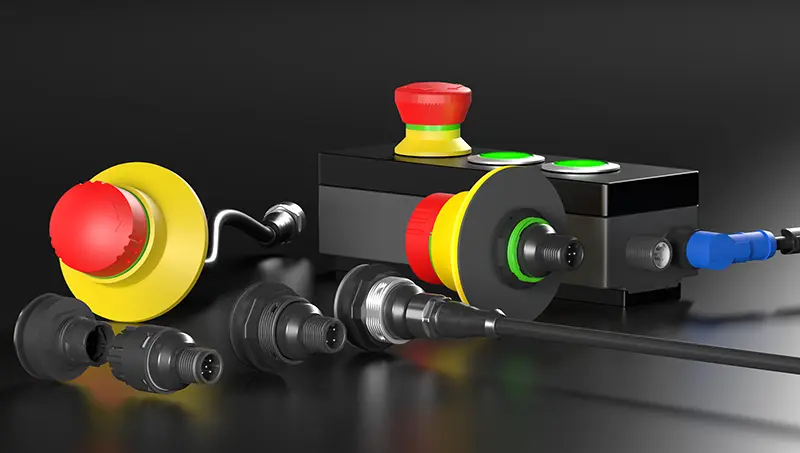
Georg Schlegel GmbH & Co. KG has integrated hygienic requirements into its product development. We offer emergency-stop devices that combine being in accordance with the norms and high cleanability. Suitable emergency-stops can be found in our Shortron or Shortron base-plate mounting series. Thanks to innovative sealing concepts, the intrusion of microorganisms into the rear side of the button is prevented.
However, a hygienic operating concept does not end with the emergency-stop. For a continuous "clean line" on the machine, pushbuttons and pilot lights also must have a hygienic design. Here, too, Schlegel offers corresponding components (Rontron-R-Juwel and Shortron base-plate mounting) that can be integrated seamlessly into hygienic plant concepts.
FAQ: hygienic HMI systems
Standard HMI systems normally do not fulfill these requirements constructively.
Which minimum degree of protection is necessary for HMI systems and emergency-stops to be suitable for the food processing industry?
For applications without direct high pressure or hot water cleaning, IP66 or IP67 may be sufficient.
In production areas with intensive wet cleaning, IP69K (acc. to DIN 40050-9) has established itself as the relevant industrial standard.
Which norms and regulations are essential for hygienic HMI systems and emergency-stop buttons?
The central normative foundations are:
DIN EN 1672‑2 (hygienic design in food technology)
EHEDG regulations
EU Regulation 10/2011 (materials with food contact)
For international applications, FDA regulations may additionally be relevant.
These sets of rules define the minimum requirements and are automatically consulted during audits.
Why is stainless steel V4A (1.4404 / 316L) the preferred material?
Stainless steel 1.4404 / 316L offers a high corrosion resistance against aggressive cleaning agents, is food-safe without additional coatings and has a smooth, non-porous surface. Thus, it is especially suitable for the permanent use in hygienic production environments.
Can capacitive touch screens be used in the food or pharmaceutical industry?
Yes, capacitive glass surfaces offer very good cleaning properties for hygienic environments due to their closed structure.
However, in production lines with obligatory protective gloves it has to be verified if the operability is given or if special versions that are compatible with gloves are necessary.
Conclusion: Hygiene is a constructive decision
Hygienic HMI systems do not occur through additional measures during operation.
They result from design.
The crucial points are:
joint-free, completely cleanable designs
durability of the material in real process conditions
permanently tight system integration
If those factores are fulfilled, the hygienic safety can be reproduced and achieved. If not, it remains dependent on the cleaning process.